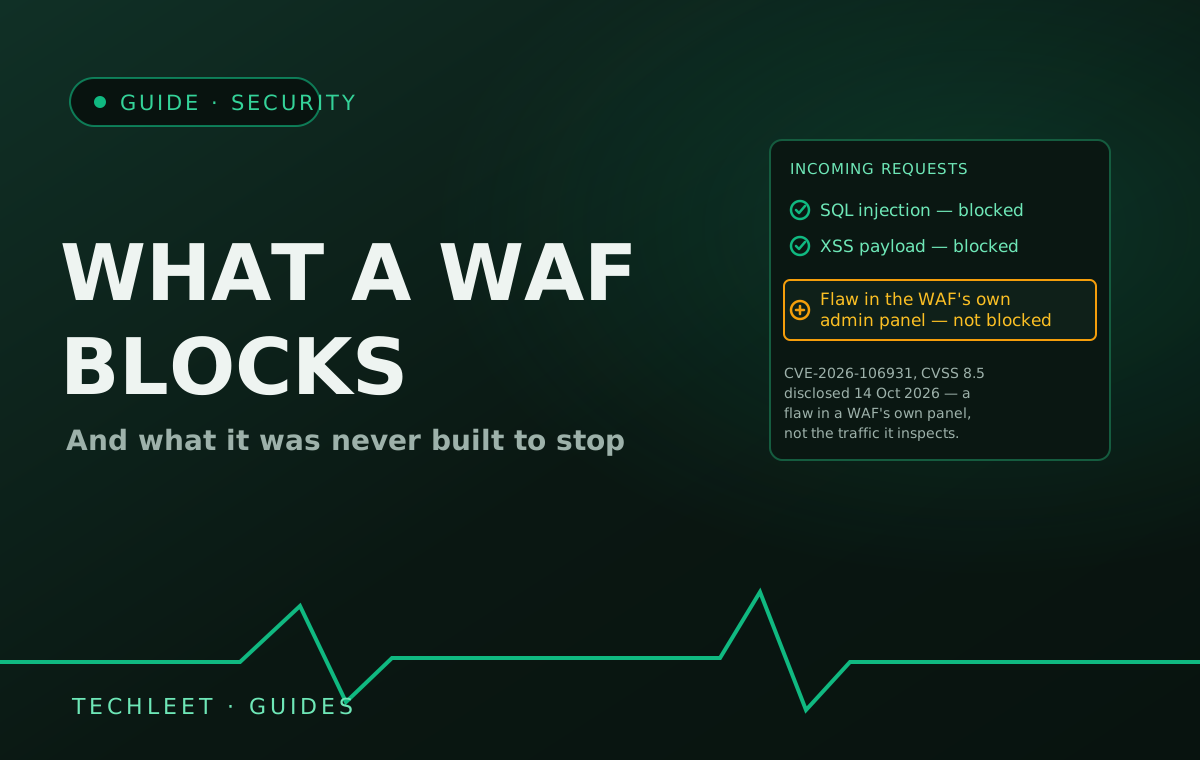
A web application firewall sits in front of a website and inspects every incoming HTTP request, blocking anything that matches a known attack pattern — SQL injection, cross-site scripting, a scan probing for a vulnerable file path — before it ever reaches the application. It is not a fix for insecure code behind it, and on 14 October 2026 that gap became literal: JPCERT disclosed a critical flaw, CVE-2026-106931 (CVSS 8.5), in a widely deployed WAF's own statistics feature, letting an attacker run commands as root or SYSTEM on a product the vendor says protects over 1.5 million sites.
That single incident is a clean illustration of the whole topic: a WAF is a layer of filtering added in front of a site, not a property the site itself gains. It can be excellent at the job it does and still leave a business exposed to everything outside that job — including, as this case shows, a flaw in the filter itself.
What a WAF actually blocks
WAF rulesets are built around the same recurring categories security researchers have tracked for years, closely mirroring OWASP's well-known list of common web application risks: injection attacks (SQL injection, command injection), cross-site scripting, known exploit signatures against specific software versions, automated scanning and credential-stuffing traffic, and requests shaped like a known CVE rather than ordinary use of a site. A WAF pattern-matches the request itself — its structure, its payload, the path it's aimed at — against rules built from attacks that have already been seen elsewhere, and rejects anything that matches closely enough.
What it was never built to stop
A business logic flaw looks like completely ordinary traffic to a WAF, because nothing about the request's structure is malicious — the bug is in what the application does with a request that is, in every technical sense, well-formed. An order form that lets a quantity go negative, or an endpoint that returns someone else's invoice because nobody checked whose record was actually being requested, passes straight through. A WAF also can't see what happens once a page has finished loading in a visitor's browser, and a sufficiently obfuscated payload — attack code rewritten in encoding its signature rules don't recognise — can slip past the exact filter built to catch its unobfuscated form.
The 14 October disclosure adds a category to that list that's easy to forget: the WAF's own software. A product built specifically to defend against attacks is still a piece of software running on a server, with its own admin panel, its own update cycle, and its own potential for an unpatched flaw — in this case, a feature meant to show traffic statistics, not accept commands from an attacker. Treating a WAF as a one-time purchase that needs no further attention is the same mistake as treating a certificate or a plugin that way; it's one more thing on the list that keeps needing maintenance, not a permanent fix installed once.
Frequently asked questions
Does a WAF mean I don't need to patch my software?
No. A WAF inspects the traffic arriving at a site and blocks requests that match known attack patterns, but the application behind it is exactly as patched or unpatched as it was before the WAF went in front of it. If an attacker finds a route the WAF's ruleset doesn't recognise, nothing downstream has changed. A WAF buys time and filters noise; it doesn't replace keeping the software itself current.
Can a web application firewall itself be hacked?
Yes, and it has happened to real, widely deployed products. On 14 October 2026, Japan's JPCERT disclosed CVE-2026-106931, a CVSS 8.5 flaw in a WAF's own statistics feature that let an attacker run commands with root or SYSTEM privileges on the server hosting it — on a product the vendor says protects over 1.5 million sites. A WAF is software like any other; its own interface is a target, not just the thing doing the blocking.
What kinds of attacks can't a WAF stop?
Business logic flaws — a checkout that lets a quantity go negative, an endpoint that returns someone else's data because nobody checked whose record was being requested — look like completely ordinary traffic to a WAF, because nothing about the request itself is malicious; the bug is in what the application does with a valid-looking request. A WAF also can't see what happens once a page has loaded in the browser, and a sufficiently obfuscated or encoded attack can be rewritten in a way its signature-matching never recognises.
Does a small business website need a WAF?
It depends what the site does, not its size. A marketing site with no login and no forms gets comparatively little benefit from one, since there's little attack surface to inspect. A site with a login, a checkout, or any form that writes to a database is a more realistic candidate, since that's exactly the traffic a WAF's signature rules are built to catch. Either way, it belongs alongside patching and access control, not instead of them.
How is a WAF different from the security headers guide?
Different layer entirely. Security headers are instructions a server sends that the visitor's own browser enforces — see our guide on security headers. A WAF sits in front of the server and inspects requests before they ever reach the application, usually as a separate service or appliance. One tells browsers what to refuse; the other filters what gets through in the first place. A site benefits from both, since neither covers what the other does.