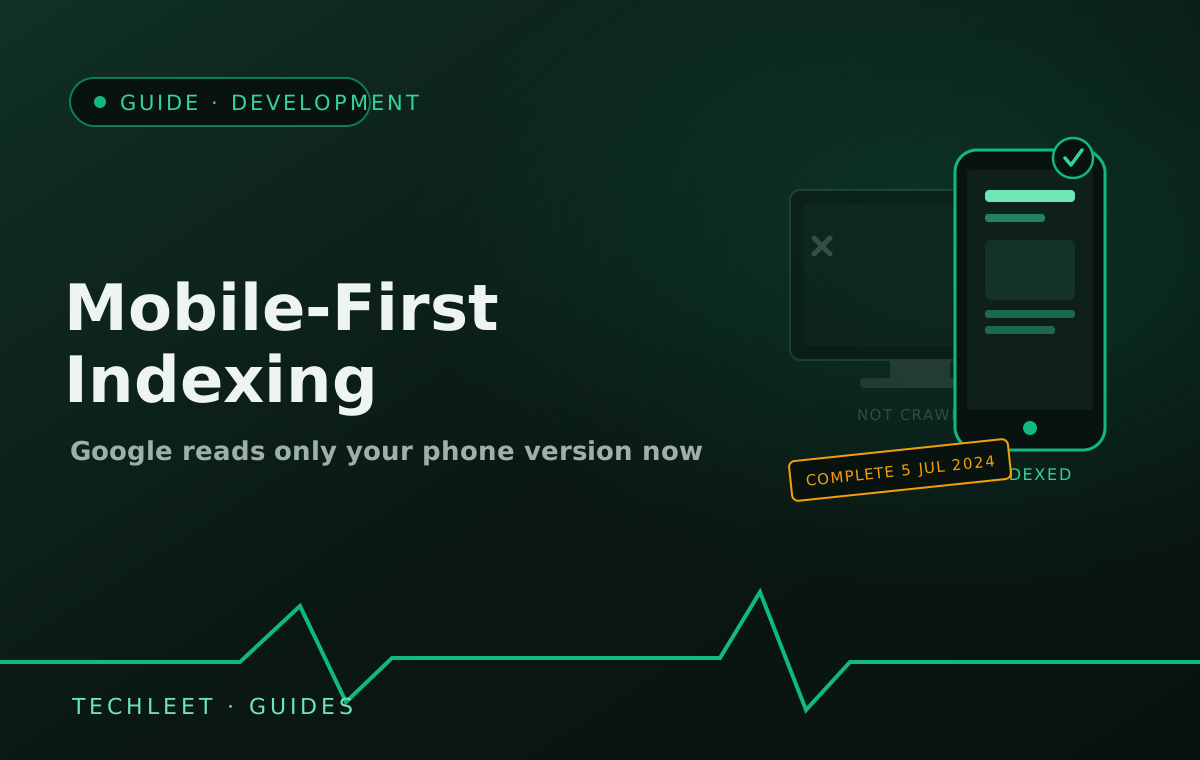
Since 5 July 2024, Google has crawled and ranked nearly every website using only the mobile version of the page — the Googlebot Smartphone crawler, not desktop. The switch took almost eight years from its 2016 announcement to reach every site on the web. If a page is missing content on mobile that exists on its desktop template, Google has not seen that content at all, not once, since that date.
We build every Techleet site mobile-first — one responsive codebase shared by phone and desktop, never two separate templates — for exactly this reason. There is no longer a desktop fallback for Google to fall back on if the mobile version comes up short, because the mobile version is the only one it reads.
Why a separate mobile site stopped being a shortcut
A decade ago, a common pattern was a dedicated mobile subdomain — m.example.com — serving a stripped-down version alongside the main desktop site. That split always carried a cost: two templates to update, and two sets of signals (content, links, structured data) that could quietly drift out of sync with each other. It used to be tolerable because Google still indexed the desktop page as the primary record. That tolerance ended on 5 July 2024. With the mobile render as the only version Google reads, a site still running a stripped-down separate mobile template is showing Google exactly the stripped-down version, permanently — not a lighter preview of a fuller desktop page sitting behind it.
Three quiet ways mobile and desktop drift apart
The failure mode is rarely a site that's unusable on a phone — most sites pass a basic mobile check. It's narrower gaps that nobody notices because the desktop version still looks complete. A section trimmed from the mobile layout "to keep things clean" — a sidebar bio, a secondary CTA, a paragraph of context — disappears from what Google reads, not just from what a mobile visitor sees. A content-management template that only wires structured data (the markup covered in our last guide) into the desktop layout leaves the mobile render with none, and the mobile render is what gets crawled. And third-party scripts — a chat widget, a booking calendar — that behave differently or fail silently on mobile change what actually renders in the one view that counts, even when the same embed works cleanly on desktop.
What actually happens if mobile is broken
Google has said plainly that a site whose content is entirely inaccessible on a mobile device risks being dropped from its index altogether — the most severe outcome, reserved for sites that genuinely don't render on a phone at all. Short of that, the realistic risk for most small business sites is narrower and quieter: a partial gap between mobile and desktop content doesn't trigger a warning or a Search Console error, it just means the gap is now permanent rather than temporary, because there's no desktop version left for Google to notice what mobile is missing. This is the same category of drift as Core Web Vitals — the mobile render is also what Google measures for LCP, INP, and CLS now, so a page that's fast on a desktop test but sluggish on an actual phone is being scored on the sluggish number, not the fast one.
Checking that the mobile and desktop renders of a page genuinely match — same content, same structured data, same working embeds — is a five-minute check with Google's own Mobile-Friendly Test or by comparing the rendered page in a phone-sized browser window, and it belongs in a recurring maintenance pass rather than a one-time launch check, the same discipline covered in our website maintenance guide.
Frequently asked questions
What is mobile-first indexing?
Mobile-first indexing means Google crawls, reads, and ranks a page using the version rendered for a smartphone (Googlebot Smartphone) rather than the desktop version. Google first announced the shift in November 2016 and rolled it out gradually — by December 2018 over half of crawled sites were already on it, and from July 2019 it became the default for every new site.
When did Google finish switching to mobile-first indexing?
Google completed the migration on 5 July 2024, nearly eight years after announcing it. A small remaining set of sites still being crawled with the desktop Googlebot were switched to the mobile crawler on that date, ending the transition for every site on the web, not just new ones.
What happens if my website isn't usable on mobile?
Google has said that if a site's content is entirely inaccessible on a mobile device, it risks being dropped from Google's index altogether. Short of that extreme, content that exists only on the desktop template — hidden sections, a desktop-only menu, text swapped out for a simplified mobile version — is content Google never crawls, because the mobile render is the only version it reads.
Do I need a separate mobile website, or is responsive design enough?
Responsive design — one codebase and one URL that reflows for any screen size — is the right approach, not a separate mobile site on its own subdomain (the old m.example.com pattern). A separate mobile site means maintaining two templates that can drift apart in content and structured data, and since mobile is now the only version Google reads, any gap between the two only hurts the mobile one Google actually sees.
Does mobile-first indexing change how Core Web Vitals or structured data are evaluated?
Yes, indirectly. Google measures Core Web Vitals from real visits, and since Googlebot Smartphone is now the primary crawler, the mobile rendering is what determines both the Core Web Vitals score and which structured data Google actually reads. If a script, ad, or embed behaves differently on mobile than on desktop, the mobile behaviour is the one that counts.