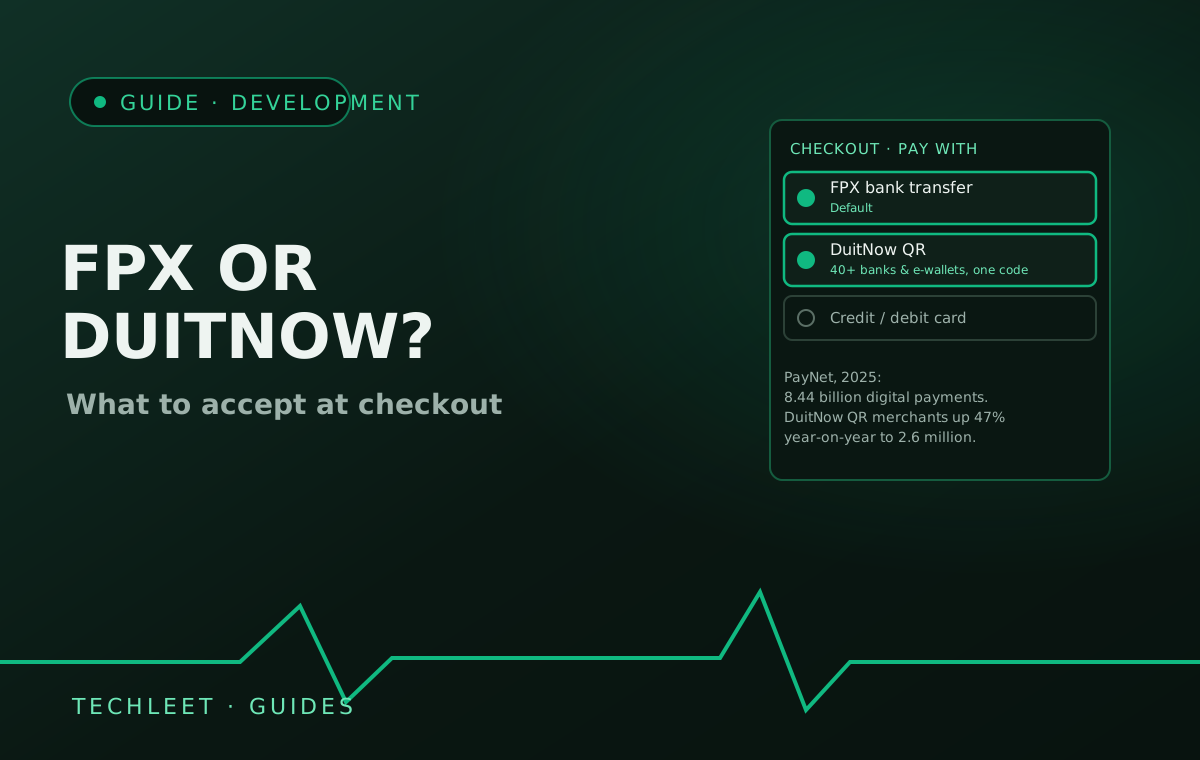
Malaysians moved 8.44 billion digital payments through PayNet's rails in 2025, and a growing share of it never touches a card: DuitNow QR merchant registrations alone jumped 47% in a single year to 2.6 million. A checkout page that leads with a card field and tucks everything else below it as a secondary option has the local market backwards — FPX and DuitNow QR are where most of that volume actually sits, and cards are the one that should be secondary.
Why the default template gets this wrong
Most ecommerce platforms and checkout plugins are built against a global default, and that default is a card field with other rails bolted on as regional add-ons. That assumption doesn't hold in Malaysia. FPX has let a customer pay straight from their own bank account, with no card involved, for well over a decade — it's the method a Malaysian online shopper has used the longest, not a newer alternative to one. A business site that imports a template and leaves FPX as an optional extra further down the checkout flow is making the least familiar method the most visible one, not the other way around.
What DuitNow QR adds that FPX didn't have
FPX still redirects a customer away from the merchant page to their bank's login screen and back, which is a fine flow for a deliberate "pay now" moment but a clumsy one on a phone mid-browse. DuitNow QR skips the redirect entirely: the customer scans a code with whichever app they already have open and confirms inside it. The code itself is the part that matters for a website owner — it's one standard, read by over 40 participating banks and e-wallets, including Touch 'n Go eWallet, GrabPay, Boost, and ShopeePay, all of which used to need their own separate wallet integration before they adopted the standard. A payment gateway that supports DuitNow QR natively hands a site all of that in one integration; building against card-only and adding wallets later means re-doing the same work four or five times.
None of this is an argument for dropping cards. International customers without a Malaysian bank account, recurring billing that doesn't suit a one-off bank redirect, and the customers who simply reach for a card out of habit are all real reasons to keep one. The fix is ordering, not elimination: FPX and DuitNow QR get the default-visible slots a Malaysian checkout earns them, and cards stay available without pretending to be the main event. Once cards are in the mix at all, the compliance side of that choice is a separate question — our guide on what changes when a site takes payments covers PCI DSS scope, and the same checkout that handles payment method choice also needs to get e-invoicing under MyInvois right if it's issuing receipts.
Frequently asked questions
Does accepting only credit and debit cards shut out Malaysian customers?
For a meaningful share of them, yes. FPX has handled online checkout directly from a bank account, no card required, for well over a decade, and PayNet's own 2025 numbers put total digital payment volume at 8.44 billion transactions — far more than card networks alone carry in this market. A checkout that only shows a card field is asking every visitor to use the one payment method that isn't the market's default.
What's the actual difference between FPX and DuitNow QR at checkout?
FPX redirects the customer to their own bank's online banking login to approve the payment, then returns them to the merchant site — a flow built for a traditional "pay now" button. DuitNow QR instead displays a code the customer scans with whichever banking or e-wallet app they already have open, approving the payment inside that app without a redirect at all. Both settle to the same merchant account; the difference is entirely in how the customer confirms the payment.
Do e-wallets like Touch 'n Go eWallet or GrabPay need their own separate checkout integration?
Not anymore for most of them. Touch 'n Go eWallet, GrabPay, Boost, and ShopeePay have all integrated with the DuitNow QR standard, so one DuitNow QR code displayed at checkout is readable by all of them plus most Malaysian bank apps — over 40 participating banks and e-wallets on a single code. A payment gateway that supports DuitNow QR natively covers this automatically; one that doesn't would need a separate SDK per wallet.
Is DuitNow QR replacing FPX?
Nothing in PayNet's figures suggests that. FPX remains the default for larger online purchases where a customer is comfortable with the bank-redirect flow, while DuitNow QR's growth — merchant registrations up 47% year-on-year to 2.6 million in 2025 — looks additive, picking up smaller and faster transactions rather than displacing FPX's existing volume.
Should a Malaysian business website still accept cards at all?
Yes, as a secondary option rather than the default. Cards still matter for international customers without a Malaysian bank account, for recurring or subscription billing where a one-off bank redirect doesn't fit well, and for the customers who simply prefer paying by card. The fix isn't dropping cards — it's not building a checkout that shows cards first and treats FPX or DuitNow QR as the afterthought.