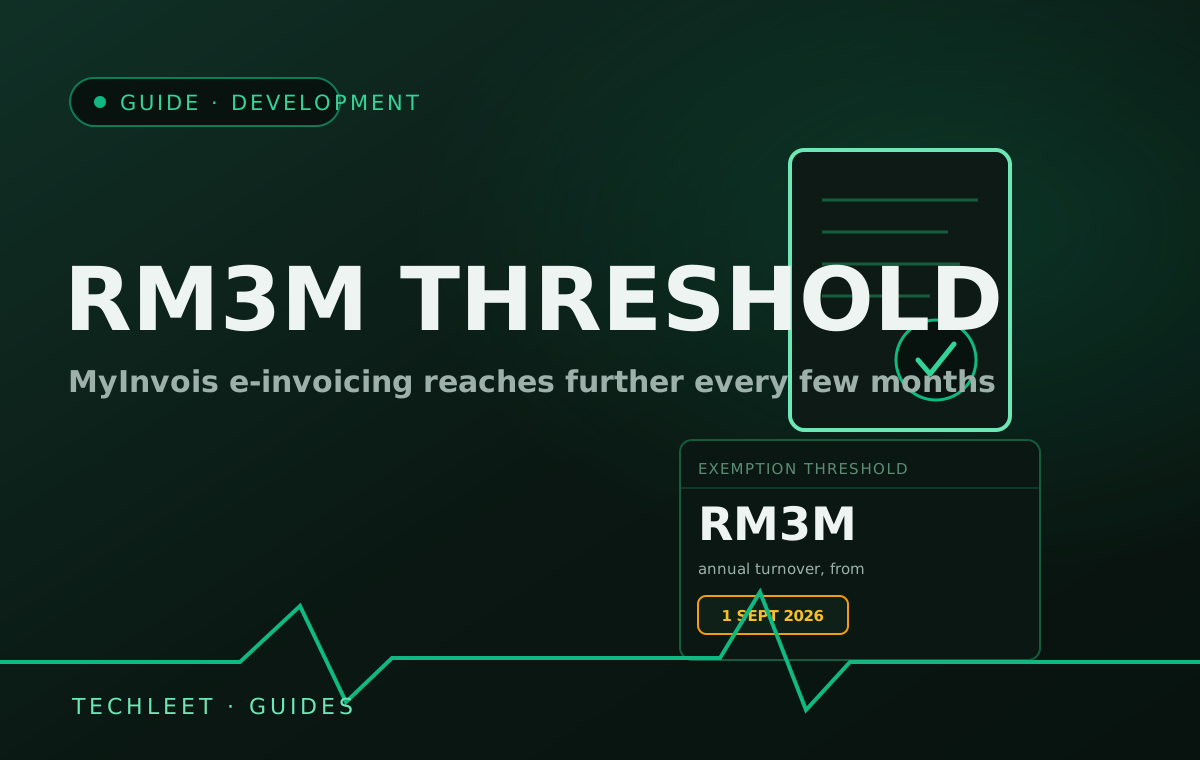
Malaysia's MyInvois e-invoicing mandate now exempts businesses under RM3 million in annual turnover — a threshold LHDN raised from RM1 million on 1 September 2026, under e-Invoice General Guideline v4.8. Above that line, a website that takes orders or payments needs more than a payment gateway: it needs its checkout or order system submitting invoice data to LHDN directly, not just processing the sale.
This isn't about PCI DSS or how card payments are processed — a site can be fully compliant on that front and still have zero e-invoicing integration, because the two obligations are entirely separate. This is about what happens to the order data after the payment clears.
Who's actually in scope, and since when
The rollout has moved in stages by annual turnover: businesses above RM100 million since August 2024, RM25–100 million since January 2025, RM5–25 million since July 2025, and RM1–5 million from January 2026. What changed the picture is the exemption threshold itself, raised twice in under a year — RM500,000 to RM1 million in December 2025, then to RM3 million on 1 September 2026 — which has quietly pulled a large slice of the original RM1–5 million band back out of scope. What's left mandatory today is the RM3–5 million band specifically, and it's been required since 1 January 2026 regardless of the later exemption change, running under a penalty-free relaxation period that Putrajaya has already extended once, now to 31 December 2027, with full enforcement currently set for 1 January 2028.
What actually needs building into the site
A business in scope has two routes, and most sites end up using both. Any single transaction over RM10,000 needs its own individual e-invoice, validated by LHDN at the moment of the sale — there's no bundling that one into anything else, whatever the phase. Everything smaller — the bulk of typical online retail — can go through a consolidated e-invoice instead: one submission covering a full calendar month's transactions, due to LHDN within 7 calendar days of month-end. Either route means the order system itself has to talk to LHDN's API (directly, or through a billing/accounting platform that already does), get back a validated reference, and keep that reference against the order — work that sits downstream of checkout, not inside it, and is easy to miss entirely if the build only ever tested that payments go through.
Frequently asked questions
Does my business need to issue e-invoices under MyInvois?
Only if annual turnover is above RM3 million — LHDN raised the exemption threshold to that figure on 1 September 2026 (e-Invoice General Guideline v4.8), up from RM1 million since December 2025 and RM500,000 before that. Businesses between RM3 million and RM5 million turnover have been in scope since 1 January 2026, with a penalty-free relaxation period running to 31 December 2027. This is a general guide, not a ruling on a specific business — confirm the current threshold and your own standing with an accountant or LHDN directly, since the figure has moved twice in under a year.
What's the difference between an individual and a consolidated e-invoice?
An individual e-invoice is validated by LHDN at the time of a specific transaction and is mandatory, regardless of phase, for any single transaction over RM10,000 since 1 January 2026. A consolidated e-invoice bundles smaller transactions — the common route for routine online orders and walk-in retail sales — into one submission covering a calendar month, which must reach LHDN within 7 calendar days of month-end.
Does accepting payments through Stripe, PayPal, or a local gateway satisfy MyInvois?
No — payment processing and e-invoicing are separate obligations. A payment gateway moves the money; MyInvois compliance means the order or checkout system also submits invoice data to LHDN's API (directly or through an intermediary) and receives back a validated reference. A site can have a fully working checkout and still have no e-invoicing integration at all.
What happens if a business in scope isn't compliant yet?
For the RM3–5 million band, the relaxation period running to 31 December 2027 allows consolidated e-invoices and limited enforcement while a business works toward full compliance — Putrajaya extended this window by a further 12 months in 2026. Full penalty enforcement is currently set to begin 1 January 2028. Relaxation is not the same as exemption, and the deadline has already moved once.
How often do MyInvois rules actually change?
Often enough that reading the rules once at launch isn't sufficient. The exemption threshold alone moved from RM500,000 to RM1 million in December 2025, then to RM3 million in September 2026, and the official guideline has already reached version 4.8. Treat the integration as something to revisit on a schedule, not a one-time build step.