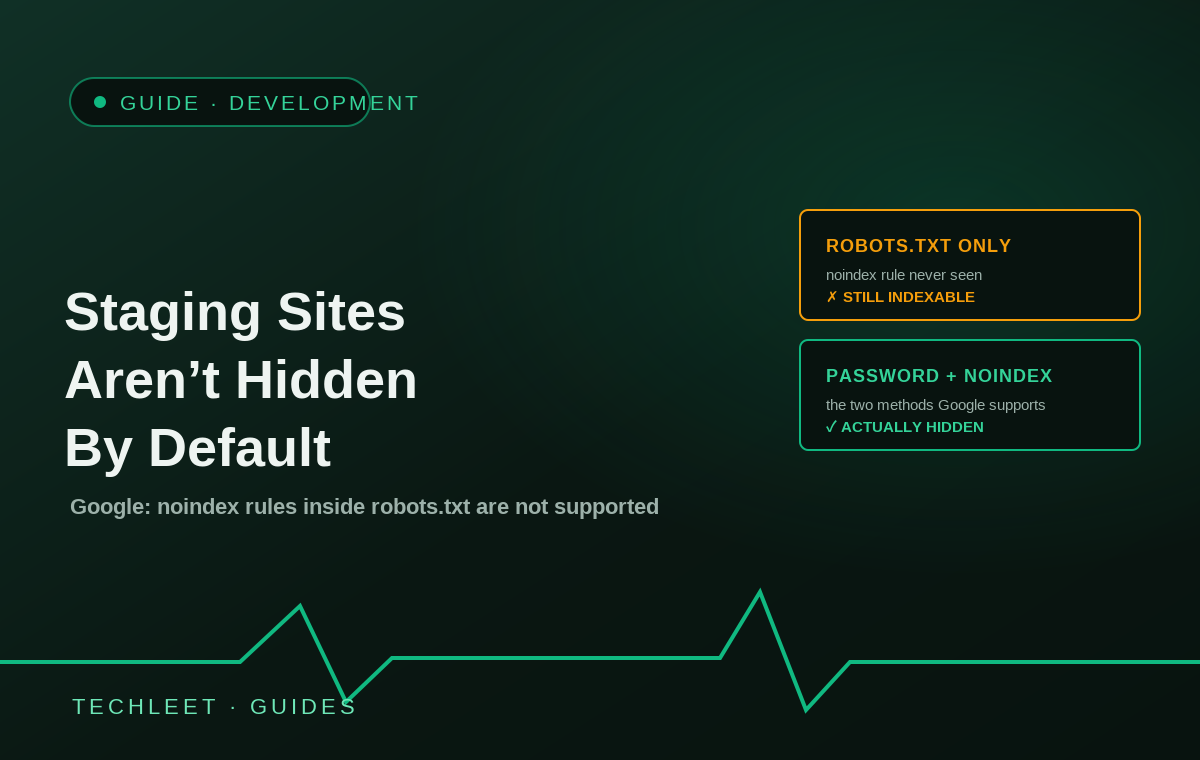
A staging site blocked only by robots.txt is not actually hidden from Google. Google's own documentation says a noindex rule placed inside robots.txt is not supported — and if robots.txt blocks the page outright, the crawler never reaches it at all, so it never sees a noindex tag on that page either. The page can still be indexed. The only combination Google's documentation actually backs is password protection plus a noindex meta tag or HTTP header.
Why a staging copy exists in the first place
Our own guides on website backups and certificate renewal both mention a staging copy in passing — the place a restore gets tested, the subdomain a certificate sometimes misses — without ever explaining what it actually is. A staging site is a copy of the live site, same code and usually a recent copy of the database, served from a separate, non-public address. It's where a change gets tried before it reaches the real thing: a plugin update, a content change, a design tweak, a new feature. Something that looks fine in a quick preview can still break a checkout flow, a contact form, or a page template once it's live in front of real visitors, and staging is the step that catches that before it costs anyone anything.
This is the same principle as testing a backup restore rather than just taking the backup and assuming it works — covered in our maintenance guide as part of what ongoing care actually includes, not a one-time launch step.
The mistake that defeats the whole point
A staging site that's meant to be private but isn't is worse than no staging site at all, because it looks protected without actually being protected. The common setup — a robots.txt file disallowing the staging path — feels like it should work, and it's wrong in a specific, documented way: Google states plainly that noindex directives in robots.txt aren't supported, and that a page blocked by robots.txt never gets crawled, which means any noindex tag sitting on that page is never even seen. The staging copy can end up indexed anyway, sitting in search results as a near-duplicate of the real site, confusing which page Google treats as the authoritative one and occasionally showing a customer a half-finished page they were never meant to see.
What an actually private staging setup looks like
Three layers, not one. Password-protect the staging environment so a crawler can't read the content at all — this alone solves most of the problem. Add a noindex rule as a meta tag or an HTTP response header, the two methods Google's own documentation confirms it supports, as a second line of defence in case the password layer ever slips. robots.txt can still disallow the staging path on top of that, mainly to keep it out of crawl budget and internal link reports — just not as the only thing standing between a test copy and a public search result. Most managed hosting setups, including our own, provision a one-click staging copy with this already wired in correctly, which is the easier starting point if nobody's checked how an existing staging setup is actually configured.
Where this sits in regular upkeep
Staging isn't a one-time setup step any more than backups or certificates are — it's the environment every update should pass through before going live, which is exactly why it belongs in a maintenance plan rather than something configured once at launch and never revisited. Our website maintenance plans treat a protected staging copy as a standing part of how a change gets made, not an occasional precaution for the riskier-looking updates.
Frequently asked questions
What is a staging site?
A copy of a live website — same code, same structure, usually a recent copy of the database too — served from a separate, non-public address. It's where a change gets tested before it reaches the real site, the same way a backup gets restored somewhere other than the live server to check it actually works.
Does blocking a staging site with robots.txt keep it out of Google?
No, and this is the part that catches people out. Google's own documentation states that specifying a noindex rule inside robots.txt is not supported. Worse, if robots.txt blocks the page outright, Google's crawler never reaches it at all — which means it never sees a noindex tag placed on that page either, and the page can still turn up in search results.
So what actually keeps a staging site private?
Layering, not a single setting. Password-protect the staging site so a crawler can't reach the content in the first place, and add a noindex rule as a meta tag or HTTP response header — the two methods Google's documentation actually supports — as a second line of defence. robots.txt can still disallow the path too, but on its own it does nothing for indexing.
Why does it matter if a staging copy gets indexed?
Two near-identical pages competing for the same search result confuses which one Google treats as authoritative, and it can split or dilute the ranking signals that would otherwise go to the real page. A staging URL showing up in results in front of a customer also just looks broken, even when nothing on the live site is actually wrong.
How does staging fit into a regular maintenance routine?
It's the step between a change being made and a change going live — every update, not just the risky-looking ones, since a small content edit can break a template just as easily as a code change. It belongs in the same ongoing category as tested backups and update cadence: a setting that's correct at launch can still drift wrong later if nobody checks it again.