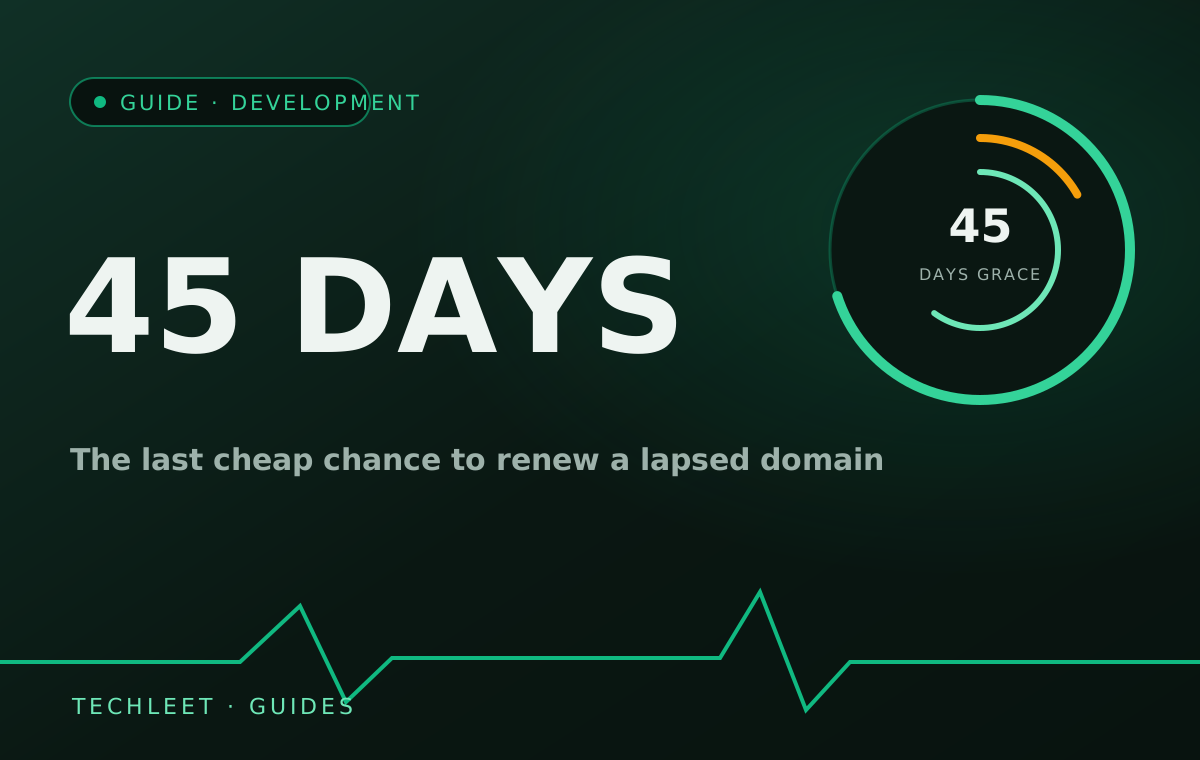
A domain that lapses doesn't disappear the moment the invoice goes unpaid. Most registrars give roughly 45 days to renew it at or near the normal price, then up to 8 days of disrupted DNS service, then a mandatory 30-day Redemption Grace Period that typically costs $100 or more to use — and once that ends, the name is gone for good, open to whoever registers it next.
Ownership protects against the wrong kind of loss
Every site we build goes live with the domain registered in the client's own name, not ours — the same no-hostage principle described in our guide on who should own the domain and hosting. That's the right call: it means nobody can hold a domain hostage over a billing dispute or a soured agency relationship. But it has a quieter side effect worth saying out loud. If the client's name is on the account, the renewal notice goes to the client's inbox, not ours — and the single most common way a well-built, well-maintained site goes dark has nothing to do with hosting quality or code. It's a renewal email that lands in a spam folder, or gets sent to the inbox of someone who left the company two years ago because the billing contact was never updated after they did.
The three clocks that actually run after expiry
Once a domain passes its expiry date, three separate windows run in sequence, each governed by ICANN policy rather than any one registrar's whim:
- Auto-Renew Grace Period — up to 45 days, during which the registrar usually still allows a normal-price renewal. Some registrars offer the full window; others cut it shorter, so the exact length depends on the account's own terms.
- DNS disruption — ICANN's Expired Registration Recovery Policy requires registrars to disrupt the domain's DNS service for up to 8 days before deletion, meaning the site and any email on that domain can stop resolving while the registration is technically still alive and still inside its grace period.
- Redemption Grace Period — a further 30 days, mandatory under ICANN policy, that starts once the domain is actually deleted. The registration can still be restored, but restoration fees of $100 or more are the norm, not the exception — registries price it as a deliberate last resort.
After the Redemption Grace Period, the domain sits in a final Pending Delete status for about five days, then releases to the public. For a short or memorable name, that release is watched closely by drop-catching services built for exactly this moment — there's no further quiet buffer once Pending Delete ends.
What a maintenance plan should actually be checking
None of this requires taking the domain out of the client's name — that would reintroduce the exact hostage risk the ownership setup exists to avoid. What it does argue for is treating the renewal date as a fact worth tracking independently of whether one email got read, the same way a maintenance plan already tracks a TLS certificate's expiry rather than waiting for a browser warning to surface it. A date on a calendar, checked a month ahead rather than discovered the week a site goes dark, is a cheap habit against an expensive clock to restart. The same discipline applies to the account's own billing details — a card that expired, or a contact email at a domain that's since changed hosting providers, is the quiet failure mode behind most "but I never got a warning" renewal lapses.
Frequently asked questions
How long after a domain expires can I still renew it at the normal price?
Most registrars offer an Auto-Renew Grace Period, typically up to 45 days after the expiry date, during which the domain can usually still be renewed at or near the normal price. The exact length and any fee are set by the registrar, not by ICANN directly, so it's worth checking your own account's terms rather than assuming the full 45 days applies to every registrar and every TLD.
Does the website go down the moment the domain expires?
Often yes, and before the domain is actually deleted. ICANN's Expired Registration Recovery Policy requires registrars to disrupt the domain's DNS service for up to 8 days before deletion, which means the website and any email tied to that domain can stop resolving while the registration is still technically alive and still inside its grace period.
What is the Redemption Grace Period and how much does it cost to use?
It's a mandatory 30-day window, set by ICANN policy, that follows a domain's actual deletion. The registration can still be restored during it, but restoration typically costs $100 or more on top of the normal renewal price — registries price it deliberately as a last resort, not a routine option.
Can someone else register my domain the moment it's released?
Yes, and quickly. Once the 30-day Redemption Grace Period ends, the domain enters a final Pending Delete status that lasts about 5 days, after which it's released back to the public. Drop-catching services specifically watch for desirable names clearing this status and can register them within seconds — there's no further quiet grace period after that.
Since Techleet doesn't control the domain, who's responsible for catching a renewal before it lapses?
Whoever's name is on the registrar account, which on every project we build is the client's from day one, not ours — the same no-hostage principle described in our domain and hosting ownership guide. The trade-off is that the renewal reminder lands in the client's inbox too, which is exactly the kind of date worth putting on a maintenance checklist rather than trusting a single email, months out, to get noticed.